Import products
Product type, coordinates, time requirements, tracking ID and other available delivery information are imported through an agreed interface.
NUNAV Courier combines fixed delivery sequences, cluster-based delivery areas and address-level parcel stops. Time-sensitive shipments and later pickups can be integrated into one route workflow.
Letters, newspapers and parcels do not have to follow the same planning logic. Product type, delivery area, sequence and time requirements determine how each job enters the route.
Product type, coordinates, time requirements, tracking ID and other available delivery information are imported through an agreed interface.
Persistent delivery areas, polygons and existing delivery sequences provide the framework for daily planning.
Flexible parcel stops and time-sensitive shipments are placed appropriately around fixed or partially fixed delivery sequences.
The driver view guides the route. Agreed delivery events and status information can be returned to connected systems.
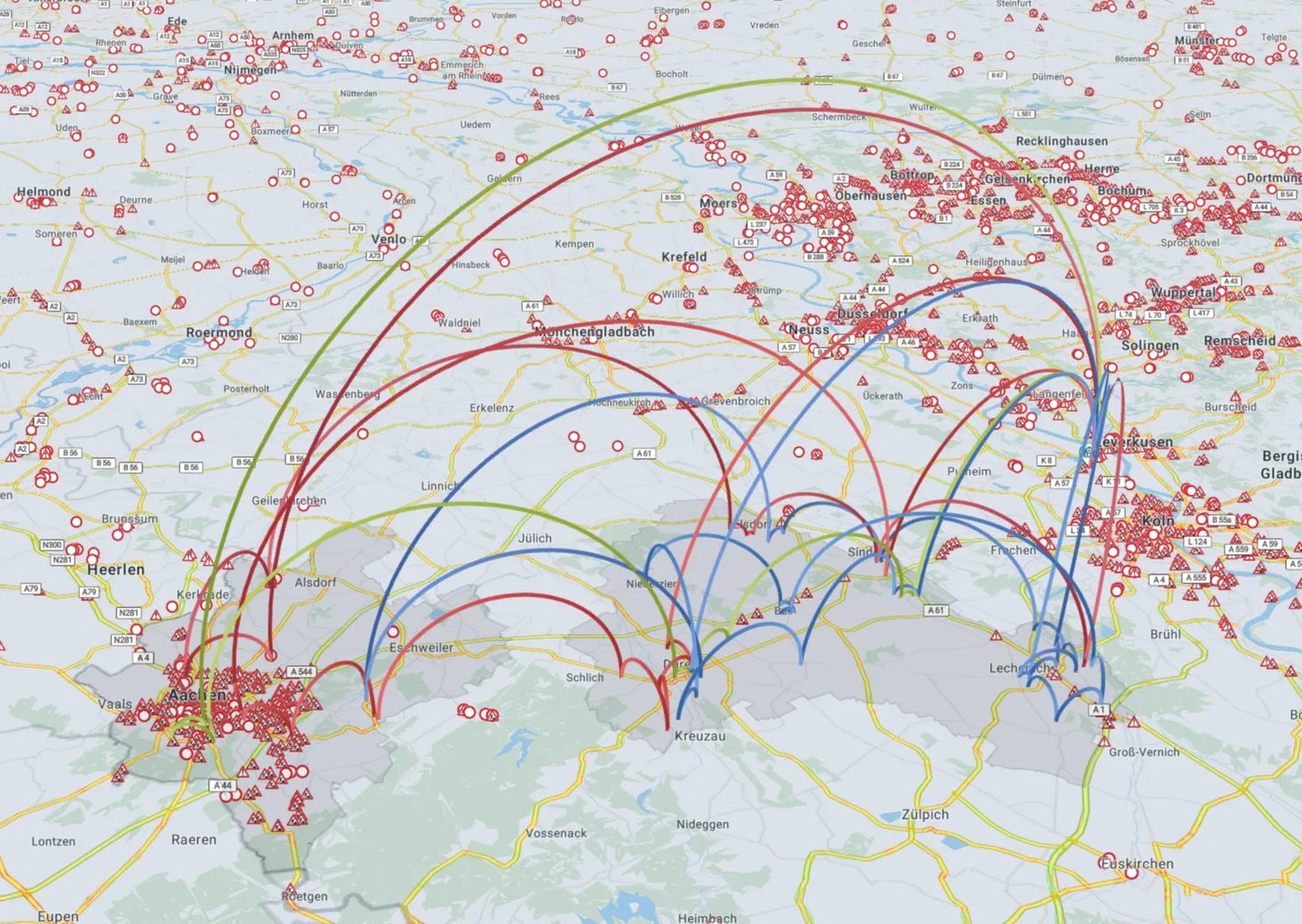
A parcel address is a different task from a connected letter or newspaper district. Planning accounts for these differences without creating separate route worlds.
Parcel jobs are planned with their own delivery address, relevant time requirements and a specific navigation destination.
Letters and newspapers in the same geographical area can be grouped into configurable delivery zones.
A fully or partially fixed order remains in place while flexible jobs are inserted in a time-optimized way.
The route is only one part of the process. Product data, pre-sorting, navigation, delivery status and recipient information need to work together through defined interfaces.
Products, delivery information and route results are exchanged through documented data structures agreed for the specific project.
Routes and sequences can be provided with relevant product attributes to prepare operational sorting.
Defined events such as loading, delivery or failed delivery can be documented through the agreed device and integration workflow.
Tracking ID, ETA, route progress and agreed metrics provide transparency for operations and recipients.
Yes. Different product types can be included in one route. Suitable rules, time requirements and information can be defined for each type.
Parcels are typically navigated as individual address-level stops. Letters or newspapers can instead be grouped into connected geographical clusters, avoiding individual handling of every item.
A sequence can be specified fully or partially. Flexible jobs are planned before, after or between the defined positions where the other rules allow it.
Yes. Delivery areas can be stored as reusable planning boundaries. Daily routes can then be created from the available products within those boundaries.
Scan events and status workflows need to be defined together with the device, app and system of record. Depending on the setup, feedback can be sent to connected systems through interfaces or webhooks.
Pickup jobs can be considered while a route is active if the required minimum information is available. The pilot defines which incomplete data is acceptable.
Every industry has its own rules, time windows and data structures. These solution pages show how dispatchers plan and steer each operation with NUNAV Studio.
We assess product data, areas, delivery sequences, time requirements and status workflows with a manageable example — including the required device integration.